
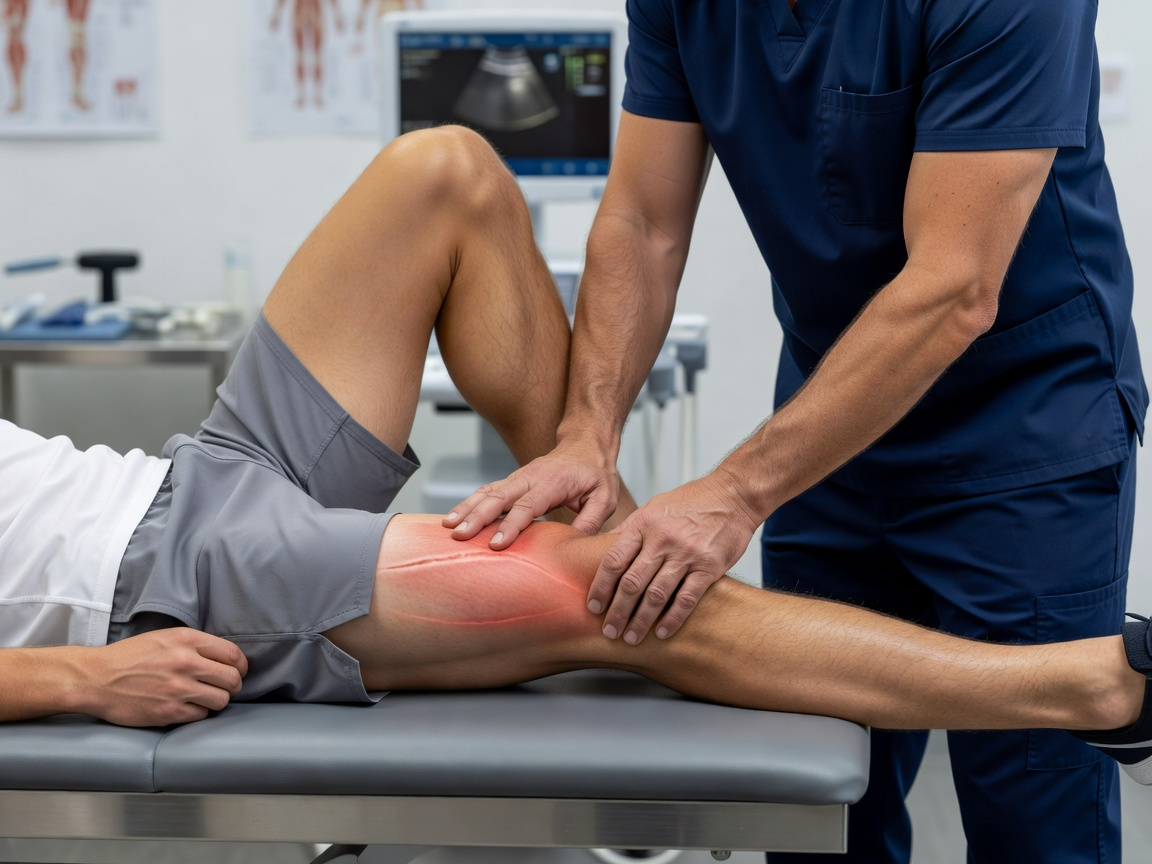
A sudden sharp pull in the back of the thigh during a sprint, an aching in the groin after a long kicking session, or tightness in the calf that develops progressively over a run are among the most common complaints of athletes across all sports in Bangalore. Muscle injuries are the most frequent cause of time lost from training and competition in field and court sports.
What is Lower Limb Muscle Injuries?
Lower limb muscle injuries range from minor grade I strains involving a small number of muscle fibres to grade III complete ruptures with full muscle tear. The most commonly affected muscles in sport are the hamstrings, the quadriceps, the gastrocnemius, and the adductors, each associated with specific sporting activities and injury mechanisms.
Types of Lower Limb Muscle Injuries
Type I
Grade I (Mild Strain): Minor tearing of a small number of muscle fibres with minimal swelling and no significant strength deficit. The athlete can typically continue activity with discomfort but without meaningful functional loss. Full recovery is expected within 1 to 2 weeks with appropriate rest and rehabilitation.
Type II
Grade II (Moderate Strain): A partial tear involving a significant proportion of muscle fibres, producing a palpable defect, visible bruising, notable swelling, and a measurable loss of strength and function. The athlete cannot continue sport at the time of injury. Recovery typically requires 3 to 6 weeks of structured rehabilitation before return to full training.
Type III
Grade III (Complete Rupture): Complete tearing of the entire muscle belly or its tendon attachment, producing total loss of the muscle's function, a visible deformity, and significant bruising. Surgical repair is required for complete ruptures of key tendons such as the proximal hamstring, patellar tendon, and Achilles tendon.
Type IV
Proximal Hamstring Avulsion: A specific and severe injury pattern in which all three hamstring tendons tear from their attachment on the ischial tuberosity of the pelvis. This is the most surgically significant lower limb muscle injury, producing profound weakness in hip extension and knee flexion. Surgical reattachment is recommended for active patients, ideally within 6 weeks of injury before retraction and scarring make repair more complex.
Type V
Myositis Ossificans: A complication of significant muscle contusion or tear in which heterotopic bone forms within the haematoma in the muscle belly, typically 4 to 8 weeks after the original injury. Most commonly seen after direct blows to the quadriceps in contact sport. Characterised by a firm, progressively hardening tender mass in the muscle that becomes visible on X-ray as it matures.
Causes
Sudden eccentric loading of a muscle during high-speed sprinting or rapid deceleration is the primary mechanism of acute muscle strains. Inadequate warm-up, fatigue, muscle imbalance between agonist and antagonist groups, and prior inadequately rehabilitated injuries all increase the risk. Proximal hamstring avulsions at the ischial tuberosity represent the severe end of the spectrum and can occur during sudden hip flexion with the knee extended.
- Sudden sharp or cramping pain in the affected muscle during activity
- A palpable defect in the muscle in more severe tears
- Immediate loss of speed and power
- Swelling and bruising developing over the following 24 to 48 hours
- Stiffness and tenderness on stretching the affected muscle

Diagnosis
Clinical examination identifies the site, severity, and functional impact of the muscle injury. Palpation localises the area of maximum tenderness and identifies any palpable defect in the muscle. Specific assessment of hamstring injuries includes the active straight leg raise test and resisted knee flexion in prone. Proximal hamstring avulsions produce a specific tender gap at the ischial tuberosity, detectable on palpation in lean patients, combined with a characteristic inability to flex the knee against resistance with the hip extended.
Ultrasound is the first-line imaging investigation for acute muscle injuries, providing dynamic real-time assessment of the tear, haematoma volume, and the integrity of the myotendinous junction. It is widely available, rapid, and allows comparison with the contralateral side. MRI provides greater anatomical detail and is the investigation of choice for proximal hamstring avulsions, where the exact number of torn tendons and the degree of retraction determine whether surgical repair is feasible and how urgently it should be performed. MRI is also preferred for distinguishing simple muscle tears from partial tendon avulsions and for confirming myositis ossificans when the clinical picture is uncertain.
Treatment
Proximal Hamstring Repair (for complete avulsion)
For complete proximal hamstring avulsion injuries, where all three hamstring tendons are torn from the ischial tuberosity, Dr. Kushalappa performs surgical reattachment of the avulsed tendons through a posterior thigh approach, using bone anchors at the ischial tuberosity. This procedure restores hamstring strength and is important for preventing chronic sciatic nerve tethering from the retracted tendon mass. Recovery involves restricted weight-bearing for 4 to 6 weeks, with progressive rehabilitation over 4 to 6 months.
Why Choose Dr. Kushalappa Subbiah in Bangalore?
Dr. Kushalappa Subbiah completed a Fellowship in Shoulder Surgery at the Sydney Shoulder Research Institute, where he trained in advanced arthroscopic shoulder procedures including labral repair and reconstruction. He holds the International Olympic Committee (IOC) Diploma in Sports Medicine, and has direct clinical experience managing shoulder injuries in Indian athletes across cricket, swimming, tennis, and contact sports. He is appointed as a Consultant Shoulder Surgeon at NH Hospital, Bangalore.
Frequently Asked Questions
The vast majority of muscle strains, including most hamstring, quadriceps, and calf injuries, are managed non-surgically with progressive rehabilitation. Surgery is reserved for complete muscle ruptures, particularly proximal hamstring avulsions, and for cases that fail to recover adequately with conservative treatment.
Grade I strains may resolve within 1 to 2 weeks. Grade II strains typically require 3 to 6 weeks of rehabilitation before return to sport. Grade III complete tears and proximal avulsions require surgical repair and rehabilitation over 4 to 6 months.